
Pushing Silicon to the Absolute Limit: The LiteRT-LM Architecture
The era of relying on cloud latency and massive server farms to run state-of-the-art language models is officially over. We are entering a new paradigm of computing where desktop-class AI lives directly on the edge.
If you are obsessed with hardware acceleration, zero-overhead memory management, and local-first development.
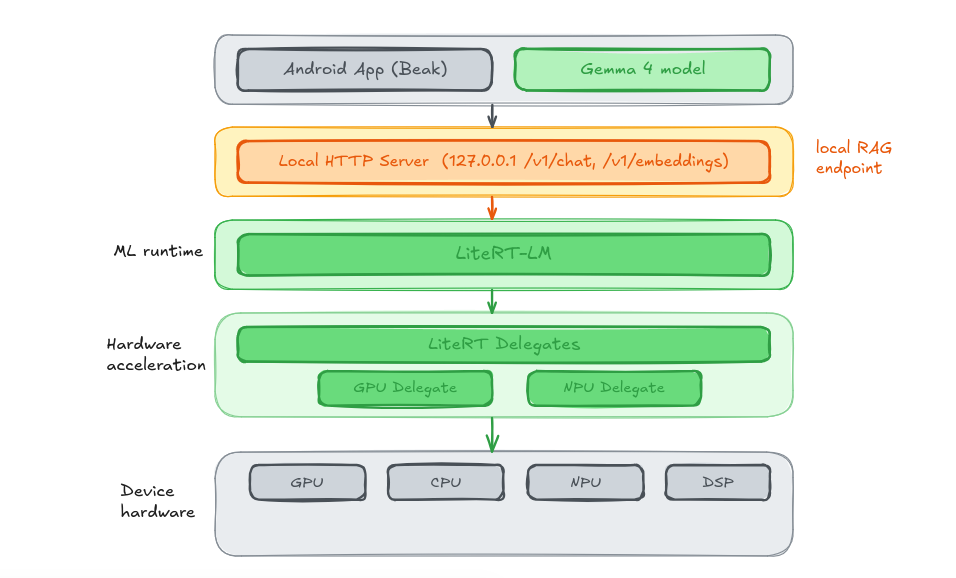
1. The Core Engine: Decoding the LiteRT-LM Architecture
Before we talk about the app, we have to talk about the engine. To run a 2GB+ quantized Gemma-4 model on a mobile device at blazing-fast token generation speeds, you cannot rely on the CPU. The CPU is a bottleneck that will melt your battery and give you 1-2 tokens per second.
This is where LiteRT-LM (Lite Runtime Language Model) steps in. It is a highly optimized ML runtime built strictly for edge inference.
Hardware Acceleration via LiteRT Delegates
LiteRT-LM completely bypasses generic CPU execution by utilizing LiteRT Delegates. These delegates are essentially low-level drivers that translate massive neural network operations (like gigantic matrix multiplications in the Transformer attention layers) directly into instructions for specialized silicon:
- GPU Delegate: Hijacks the device’s Graphics Processing Unit. Since GPUs are inherently designed for massive parallelization, they chew through vector math.
- NPU Delegate: This is the holy grail. The Neural Processing Unit is dedicated AI silicon. Bounding inference to the NPU gives us an insane multiplier on token-per-second throughput while simultaneously dropping power consumption to the floor.
- DSP: The Digital Signal Processor is kept in reserve for ultra-low-power continuous compute tasks.
The ML Runtime Layer
Sitting just above the delegates, the LiteRT-LM C++ Runtime orchestrates the brutal reality of running LLMs:
- KV-Cache Memory Management: It dynamically maps the Key-Value cache in native memory, ensuring that history context doesn't require quadratic re-computation.
- Native Tokenization: Uses blazing-fast, C++ level SentencePiece tokenization natively during the prefill phase, seamlessly injecting
<bos>(Beginning of Sequence) tokens before the Flutter layer even knows what's happening.
2. The Beak Project Architecture: A Zero-Overhead Bridge
Seamless FFI and Dynamic Routing
Through the flutter_gemma package, Beak uses Dart Foreign Function Interfaces (FFI) to communicate directly with the LiteRT-LM C++ binaries. There is no heavy serialization tax here.
Furthermore, the architecture allows for Dynamic Model Switching. Beak can hot-swap multi-gigabyte models (like gemma-4-E2B-it or embeddinggemma-300m) straight from Hugging Face, tearing down the native session and mapping a new one into memory instantly.
Core Architectural Principles in Action
Beak is built on strict engineering principles:
- Concurrency Protection: Managing a monolithic native session requires surgical precision. Beak employs a strict generation Mutex lock (
_isBusy) at the server layer. If a rogue request hits while a model is loading or generating, it safely bounces with a503 Service Unavailable, guaranteeing the native KV-cache never corrupts. - Template Strictness: We extract
systemprompts and inject them directly via native instruction templates, meaning the model never hallucinates or drifts into other languages.
3. The Local RAG Endpoint: Revolutionizing Local Development

Beak doesn't just consume the AI; it serves it. Built directly into the architecture is a Local HTTP Server running entirely on-device (bound to 0.0.0.0:8080). Powered by a robust Foreground Service, this server stays alive even when the app is in the background, transforming your phone into a dedicated AI API node on your local Wi-Fi network.
How It Turbocharges Local RAG Development
If you are building Retrieval-Augmented Generation (RAG) applications on your laptop, you usually have two bad options: pay for OpenAI API credits (destroying privacy and your wallet), or fry your laptop's GPU trying to host a local model while writing code.
With Beak, you get a third option: Offload the inference to your phone.
Beak exposes 100% OpenAI-compatible endpoints:
POST /v1/embeddings: Shoot your documents over the LAN. Beak routes them to the active embedding model and fires back high-dimensional vectors instantly.POST /v1/chat/completions: Send your retrieved context. Beak queues the request securely through the Mutex lock, hits the NPU, and streams the generated response back to your laptop.
Example RAG Integration:
# Generating Embeddings from your laptop targeting your phone's IP!
curl http://192.168.1.15:8080/v1/embeddings \
  -H "Content-Type: application/json" \
  -d '{"model":"embeddinggemma-300m","input":"your RAG document text"}'

# Querying the LLM
curl http://192.168.1.15:8080/v1/chat/completions \
  -H "Content-Type: application/json" \
  -d '{"model":"gemma-4-E2B-it","messages":[{"role":"user","content":"Analyze this context..."}]}'
By unifying hardware-accelerated LiteRT-LM inference with an OpenAI-compatible local server, Beak proves that the future of RAG development isn't in the cloud it's sitting right in your pocket.